
Public Symposium
“The War in Ukraine and European Security”
January 22 ,2026
Japan Forum on International Relations (JFIR)
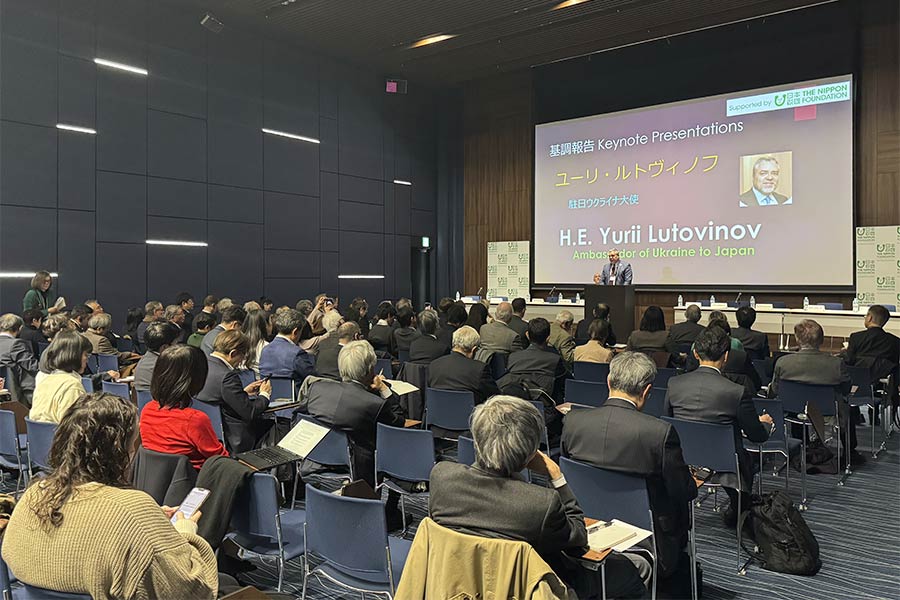
The Japan Forum on International Relations (JFIR), in cooperation with the Kasumigaseki Foreign Service Association (KaFSA), and co-hosted by of The Nippon Foundation, held a public symposium entitled “The Ukraine War and European Security” on January 22, inviting several Ambassadors of EU member states to Japan as panelists. An overview of the symposium is as follows.
1.Date and Time: Thursday, January 22, 2026 from 2:30-4:45pm
2.Place:International Conference Hall, The Sasakawa Peace Foundation
3.Attendees: About 200 members
4.Program
Moderator: Dr. WATANABE Hirotaka, Distinguished Research Fellow, JFIR / Professor, Teikyo University /
Professor Emeritus, Tokyo University of Foreign Studies
14:30~14:45
Opening Remarks :
Ms. WATANABE Mayu, President, JFIR
Amb. KAWAMURA Yasuhisa, President, KaFSA
14:45~16:10
Keynote Presentations :
H.E. Jean-Eric Paquet, Ambassador of the European Union to Japan
H.E. Yurii Lutovinov, Ambassador of Ukraine to Japan
H.E. Paweł Milewski, Ambassador of Poland to Japan
H.E. Tanja Jääskeläinen, Ambassador of Finland to Japan
H.E. Viktoria Li, Ambassador of Sweden to Japan
Mr. Martin Huth, Deputy Head of Mission, Embassy of Germany to Japan
16:10~16:50
Panel Discussion with the Keynote Speakers, joined by :
Amb. YANAGI Hidenao, Former Ambassador of Japan to Germany
Amb. MATSUDA Kuninori, Former Ambassador of Japan to Ukraine
Dr. WATANABE Hirotaka, Distinguished Research Fellow, JFIR
Dr. ITO Takeshi, Professor, The University of Tokyo
Closing:
5.Introduction of the Panelists
Dr. WATANABE HirotakaDistinguished Research Fellow, JFIR / Professor, Teikyo University /
Professor Emeritus, Tokyo University of Foreign Studies
Dr. WATANABE Hirotaka graduated from the Tokyo University of Foreign Studies (B.A. in French Studies) in 1978 and completed the doctoral program at Keio University in 1983. He subsequently completed the doctoral program in Contemporary International Relations History at Université Paris I Panthéon-Sorbonne in 1986.He has held academic positions including Associate Professor and Professor at the Tokyo University of Foreign Studies, and later served as Professor at the Graduate School of Global Studies, as well as Director of the Institute of International Relations at the same university (2011). In addition to his academic career, he has served as Minister for Public Diplomacy at the Embassy of Japan in France, and as Editor-in-Chief of the Japanese diplomatic journal Gaiko and the French-language journal Cahiers du Japon. Dr. Watanabe has also been a Visiting Professor at institutions including the École des Hautes Études en Sciences Sociales (EHESS), École Normale Supérieure de Lyon, Sciences Po Bordeaux, and the Elliott School of International Affairs, George Washington University. In 1992, he received the Shibusawa–Claudel Prize for his book France in the Mitterrand Era. He is the author and editor of numerous books and publications on European and transatlantic international relations. Fields of Expertise: European International Relations, Transatlantic Relations, Contemporary European Politics.
【Opening Remarks】
Ms. WATANABE MayuPresident, the Japan Forum on International Relations (JFIR)
Graduated from Chiba University. Received M.A. In Education from the Graduate School of The University of Tokyo in 1997. Joined the Japan Forum on International Relations (JFIR) in 2000 and was appointed Senior Research Fellow in 2007, during which period she specialized in global human resource development and public diplomacy. She served as Director in 2011, Executive Director in 2017, Vice President in 2018, and President in 2019. She was concurrently serving as President of the Global Forum of Japan and President of the Council on East Asian Community.
Amb. KAWAMURA YasuhisaPresident, the Kasumigaseki Foreign Service Association (KaFSA)
Graduated from Hitotsubashi University in 1981 and from Amherst College, USA in 1984, joined the Ministry of Foreign Affairs of Japan in 1981, served as Counsellor at the Mission of Japan to the European Union in 2002, Deputy Consul General of Japan in New York in 2012, Deputy Chief of Mission at the Embassy of Japan in India in 2013, Director-General for Press and Public Diplomacy and Foreign Press Secretary in 2015 (responsible for strategic communication and public diplomacy), Ambassador and Deputy Permanent Representative of Japan to the United Nations in 2017 (engaged in issues including North Korea, Peace Keeping Operation and peacebuilding as a member of the UN Security Council), Ambassador of Japan to Canada in 2019 (advancing cooperation toward a Free and Open Indo-Pacific), Member of the Japanese National Commission for UNESCO since 2022 (incumbent), Board Member of the Kasumigaseki Foreign Service Association (KaFSA) in 2022, and serving as President since 2025.
【Keynote Presentations】
H.E. Jean-Eric Paquet Ambassador of the European Union to Japan
H.E. Jean-Eric Paquet is the Ambassador of the European Union (EU) to Japan since autumn 2022. He held various mandates at the European Commission, where he contributed in shaping EU policy in various fields. As the Director-General for Research and Innovation from 2018 and 2022, he set up the European Innovation Council and promoted a whole-of-government approach for R&I, notably via the creation of several EU Missions to solve major ecological, societal and economical challenges. He gained considerable experience at international level as Director for the Western Balkans in the Directorate-General for European Neighbourhood and Enlargement Negotiations and as EU Ambassador to the Islamic Republic of Mauritania from 2004 to 2007. From 2015 to 2018, he was Deputy Secretary-General of the European Commission, in charge of Better Regulation and Policy Coordination, covering all policy areas related to the EU Green Deal. He also led the development of the Trans-European Transport Network Policy and was responsible for Europe’s transport infrastructure policy and investment strategies, the single European rail area, inland waterways and port policy. In all his endeavours, he puts co-creation and systemic change at the heart of the decision-making process, and strongly believes that citizens should be more involved in shaping public policy agendas.
H.E. Yurii LutovinovAmbassador of Ukraine to Japan
Graduated from Taras Shevchenko National University of Kyiv, Faculty of Foreign Philology, Department of Oriental Studies in 1996, and from the Hennadiy Udovenko Diplomatic Academy of Ukraine of the Ministry of Foreign Affairs with a Master’s Degree in Foreign Policy in 2006. Joined the Ministry of Foreign Affairs of Ukraine in 1995, serving as Attaché, Third Secretary and Second Secretary in the Asia-Pacific Division of The Asia-Pacific, Middle East and Africa Department of the Ministry of Foreign Affairs (1995–1998). Served at the Embassy of Ukraine in Japan as Third Secretary and Second Secretary (1998–2004), and later as First Secretary and Counsellor (2007–2012). Worked as First Secretary at the Asia-Pacific Division of the Ministry of Foreign Affairs (2006–2007). From 2012 to 2015, served as Director of the Division of South-East Asia and Oceania at the Ministry of Foreign Affairs of Ukraine. Served as Minister-Counsellor at the Embassy of Ukraine in Japan from 2015 to 2021. In 2022–2023, served as Deputy Director-General of the Department of State Protocol at the Ministry of Foreign Affairs of Ukraine. From 2023 to 2025, served as Director of the Division of European Integration at the Department for European and Euro-Atlantic Integration, and subsequently as Deputy Director-General of the Directorate for European and Euro-Atlantic Integration at the Office of the President of Ukraine. Arrived to Japan in 23 September 2025.
H.E. Paweł MilewskiAmbassador of Poland to Japan
Born in 1975, Pawel Milewski received his M.A. in Chinese Studies from Adam Mickiewicz University in 1999, studied at Capital Normal University (China) in 1996, followed by Xiamen University (China) in 1997. From 2003 to 2009, he worked at the Embassy of the Republic of Poland in the People’s Republic of China as Second Secretary, First Secretary and Counsellor. In 2013, he was appointed Ambassador of the Republic of Poland to Australia. During this period, he also served as Ambassador of the Republic of Poland to Papua New Guinea. In 2017, he was appointed Director General of the Bureau for Asia and the Pacific, Ministry of Foreign Affairs of the Republic of Poland. He arrived in Japan in October 2019 as Ambassador of the Republic of Poland to Japan.
H.E. Tanja JääskeläinenAmbassador of Finland to Japan
H.E. Tanja Jääskeläinen entered the Finnish Foreign Service in 1995. She has since held a wide range of diplomatic and senior policy positions, including Second Secretary at the Embassy of Finland in Budapest; Deputy Head of Mission and First Secretary at the Embassy of Finland in Damascus, Syria; Deputy European Correspondent and Counsellor in the European Common Foreign and Security Policy Unit of the Political Department, Ministry for Foreign Affairs; Senior Adviser to the Minister for Foreign Affairs of Finland; and Minister and Deputy Head of Mission at the Embassy of Finland in London. She later served as Ambassador Extraordinary and Plenipotentiary of Finland to Tunisia, with concurrent accreditation to Libya, and subsequently as Special Representative (Ambassador) for the Syria Crisis in the Middle East and North Africa Unit of the Ministry for Foreign Affairs. She also served as Deputy Director General of the Political Department of the Ministry for Foreign Affairs. Since September 2022, she has been serving as Ambassador Extraordinary and Plenipotentiary of Finland to Japan.
H.E. Viktoria LiAmbassador of Sweden to Japan
Joined MOFA in 1995, posted in Zagreb, EU Representative, Rome, and Beijing. After, served as Consul General in Shanghai, Ambassador in Prague, Deputy Director General - Head of Communications Department at home ministry. Holds Master of Laws (Stockholm University 1993), Post-graduate Degree in International Relations (Amsterdam School of International Relations 1994), Master of the Rights of the Child (Fribourg University 2005).
Mr. Martin HuthDeputy Head of Mission, Embassy of Germany to Japan
Martin Huth studied Law at the University of Konstanz before joining the Federal Foreign Office in 1991. He has served in various positions in the Middle East as well as in Geneva and New York. He was German Ambassador to Lebanon from 2015-2018 and EU Ambassador to Iraq from 2019 to 2021.
【Panel Discussion】
YANAGI HidenaoFormer Japanese Ambassador to Germany
Graduated from University of Tokyo, Faculty of Culture and Natural Art(International Relations), and joined the Ministry of Foreign Affairs of Japan in 1982. Studied at University of Konstanz in Federal Republic of Germany from 1983-1985 and Served in Germany five times for more than 15 years. In HQ, served at various divisions (Economic Affairs Bureau, division of Korean Peninsula, division of Japan-US Security Treaty, Development Assistance Bureau, Intelligence and Analysis Bureau and Foreign Policy Bureau), In 2004 Minister (Economic) of Embassy in India, In 2006 Minister (Political) of Embassy in Germany, In 2009 Seconded to Cabinet Secretariat, Served in HQ, Deputy Director General of Consular Affairs Bureau, Disarmament, Non-Proliferation and Scientific Affairs Department and Southeast and Southwest Asian Affairs Department from 2012 to 2014. Consul-General in Munich in April 2014, Ambassador of Japan to Jordan in December 2017, and Ambassador of Japan to Germany from November 2020 to October 2024, Retired in November 2024.
Amb. MATSUDA KuninoriFormer Ambassador of Japan to Ukraine
Amb. MATSUDA Kuninori graduated from the College of Arts and Sciences, The University of Tokyo in 1982 and entered the Ministry of Foreign Affairs of Japan in the same year. Over the course of his diplomatic career, he has held a wide range of senior positions, including First Secretary at the Embassy of Japan in the United States, Counsellor at the Embassy of Japan in Russia, Director of the Overseas Public Relations Division at the Ministry of Foreign Affairs, Senior Research Fellow and Director of the Research Coordination Division at the Japan Institute of International Affairs, and Minister at the Embassy of Japan in Israel. He also served as Consul General of Japan in Detroit, Consul General of Japan in Hong Kong (with ambassadorial rank), and Ambassador Extraordinary and Plenipotentiary of Japan to Pakistan. From October 2021 to October 2024, Amb. Matsuda served as Ambassador Extraordinary and Plenipotentiary of Japan to Ukraine, during a period marked by the outbreak and continuation of the war. Following his retirement from diplomatic service, he published a book reflecting on his diplomatic experience under wartime conditions, and continues to share insights through lectures and public engagements.
Dr. ITO TakeshiProfessor, Graduate School of Arts and Sciences, The University of Tokyo
Dr. ITO Takeshi graduated from the Faculty of Law, The University of Tokyo in 1995 and completed his Master’s degree in Law and Political Science at the same university in 1997. He subsequently entered the doctoral program at the Graduate School of Law and Politics and was selected as a JSPS Research Fellow (DC1). He later withdrew from the doctoral program in 1998 upon appointment as a research assistant. From 1998 to 2002, he served as Research Associate at the Institute of Social Science, The University of Tokyo, and subsequently held positions as Project Researcher and Project Lecturer at the Graduate School of Law and Politics, The University of Tokyo. In 2006, he joined Senshu University, Faculty of Law, where he served successively as Lecturer, Associate Professor, and Professor. In 2018, Dr. Ito was appointed Associate Professor at the Graduate School of Arts and Sciences, The University of Tokyo, and has served as Professor since 2019. He has also been a Visiting Researcher at the University of Florence, Faculty of History, and a Visiting Research Fellow at the Robert Schuman Centre for Advanced Studies, European University Institute (EUI). Dr. Ito is the author and editor of numerous books and publications on European politics and Italian political history. Fields of Expertise: Comparative European Politics, Italian Politics, Democracy Studies.
(Order of Program Appearance)
6.Summary :
In the keynote presentations, representatives from the European Union (EU) expressed the recognition that Russia’s invasion is not merely a regional conflict, but a challenge to the very foundations of the postwar international order, including respect for sovereignty, the inviolability of borders, and the rule of law. It was explained that the EU and its Member States have made clear their position that supporting Ukraine is essential to safeguarding Europe’s own security, and are advancing a comprehensive approach encompassing the strengthening of defense capabilities, sanctions measures, the utilization of frozen assets, and consideration of future security guarantees.
From the Ukrainian side, it was emphasized that the nature of the war Ukraine faces is not simply one of territorial defense, but a struggle to protect the right of its people to choose their own path. Even as discussions toward peace proceed, it was underscored that there exist “non-negotiable principles,” namely sovereignty, territorial integrity, and security guarantees, and a strong warning was issued that an inadequate peace settlement could invite renewed aggression in the future. It was also noted that Ukraine is not only a recipient of assistance, but a country capable of contributing to the security of Europe as a whole through its combat experience and defense industry.
Speakers from Poland, Finland, Sweden, and Germany reported that Russia’s invasion has fundamentally altered their respective threat perceptions, prompting changes in defense policy, relations with NATO, levels of defense investment, and efforts to strengthen whole-of-society resilience. In particular, it was shared that in the Nordic and Central and Eastern European countries, Russia is regarded as a long-term security threat, and that deterrence is being rebuilt through substantial increases in defense spending as well as strengthened NATO membership and engagement. Responses to non-military means such as hybrid attacks, cyberattacks, and threats to critical infrastructure were also identified as important challenges for European security.
During the panel discussion, views were exchanged regarding the conditions for ending the war and the feasibility of a peace process. The importance of a sustainable and just peace, rather than a short-term compromise, was reaffirmed. While concerns were expressed about possible weakening of European unity, there was an overall shared assessment that Europe is undergoing a “strategic awakening” and is seeking to assume greater agency and responsibility in the field of security.
Furthermore, it was repeatedly emphasized throughout the discussion that the war in Ukraine is not an issue confined to Europe, but is inseparable from the security of the broader international community, including the Indo-Pacific region. Under the recognition that “today’s Ukraine could become tomorrow’s East Asia,” the need for Japan and European countries to deepen cooperation in order to uphold a rules-based international order was reaffirmed.
In sum, the symposium provided an opportunity to examine from multiple perspectives the transformation of European security brought to light by the war in Ukraine, and to clarify the significance of its experiences and lessons for the international order and for Japanese diplomacy.
In addition to numerous representatives from European embassies and other diplomatic missions in Tokyo, the symposium was attended by Zigmārs Zilgalvis, Ambassador of Latvia to Japan; Martin Klučar, Ambassador of the Czech Republic to Japan; Aurelijus Zykas, Ambassador of Lithuania to Japan; and Yannis Michaelides, Ambassador of Cyprus to Japan.
Following the conclusion of the symposium, a cocktail reception was held with the participation of the speakers and representatives of the organizing and co-hosting institutions. After a toast delivered by OGATA Takeju, Chairman of The Nippon Foundation, participants further deepened their exchanges.
Prepared by the Secretariat